Why I Dislike the Glock 19 Despite Its Reputation

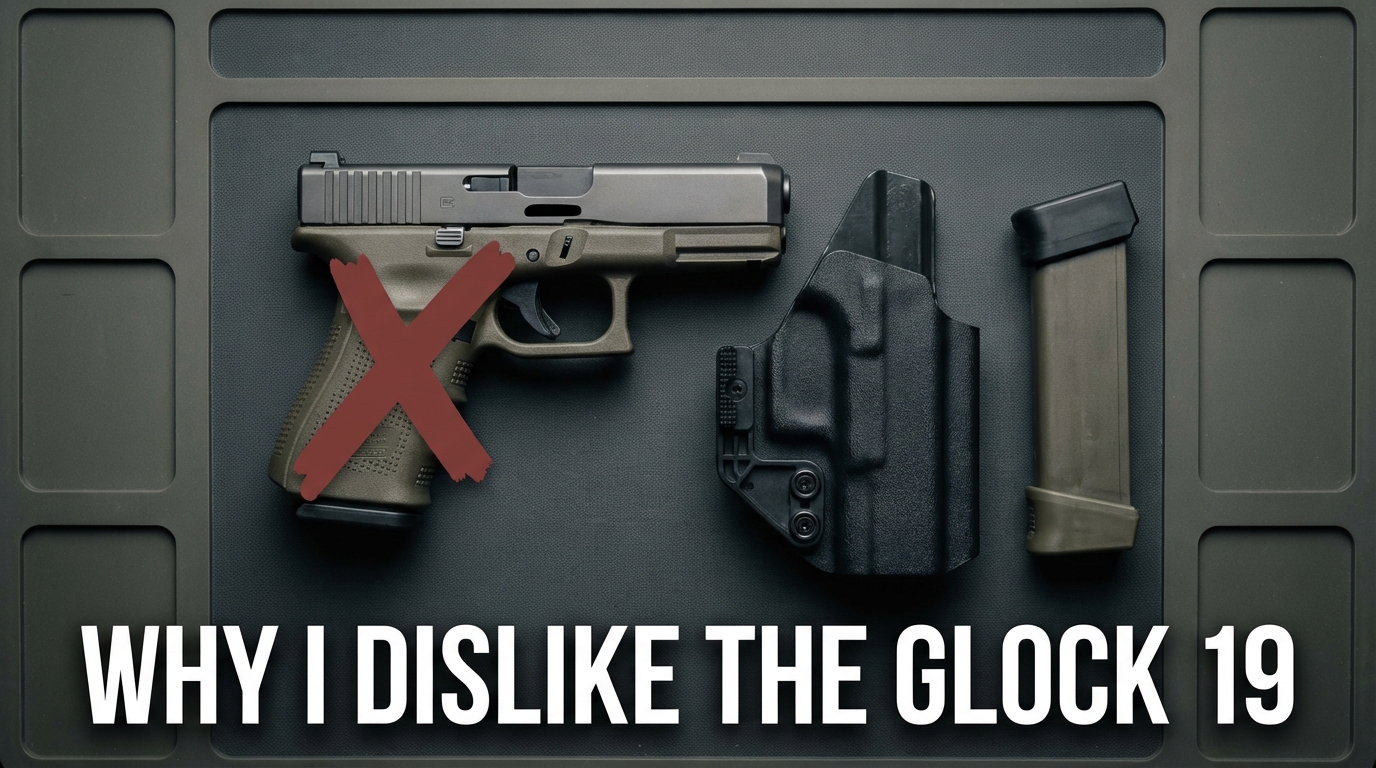
I know what you’re thinking. Who criticizes the Glock 19? It’s the “perfect” pistol. Every instructor recommends it. Every gun store employee pushes it. The internet has basically canonized it as the one handgun you need to own before you die. I carried one for two years, shot thousands of rounds through it, and competed with it in USPSA. And after all that, I sold it. Not because it’s a bad gun – it isn’t. But because “not bad” and “right for me” are two very different things. This article is my honest take on why the G19 never worked for me, what I noticed after serious range time, and what I’d tell anyone who feels the same frustration but can’t figure out why.
The Grip Angle That Threw Off My Aim
The Glock’s grip angle sits at roughly 22 degrees – noticeably steeper than a 1911 or an M&P. For some shooters, that angle feels completely natural. For me, it never did. Every time I drew from the holster, the muzzle pointed slightly high, and I had to consciously correct before breaking the shot.
This isn’t a small thing in competition or defensive shooting. When your natural point of aim is off, you are burning mental bandwidth on a correction that should be automatic. After two years, I kept waiting for my muscle memory to adapt. It never fully did. Some shooters adapt quickly – I’ve seen it – but if you’re still fighting the grip angle after thousands of rounds, that’s a signal worth taking seriously.
Why the Trigger Feel Never Clicked for Me
The Reset Problem
The stock Glock 19 trigger has a mushy take-up, a somewhat vague wall, and a reset that I always struggled to feel consistently under pressure. In dry fire it was manageable. Under match stress, I kept over-resetting or short-stroking it. That’s a me problem, partly – but the trigger design didn’t help.
I’ve shot triggers that give you a crisp, tactile reset you can feel without thinking. The G19’s stock trigger just doesn’t do that. Plenty of aftermarket options exist – connector swaps, trigger shoe upgrades – and they do improve things. But the fact that most serious shooters immediately upgrade the trigger tells you something about where it starts.
What a Better Trigger Actually Feels Like
A good trigger for practical shooting should have:
- A short, consistent take-up with no mushiness
- A clean, defined break – no creep
- A positive, audible reset you can feel under stress
- Predictable reset distance (not too long, not too short)
The G19 stock trigger hits maybe two of those four for me.
How the Size Falls Into an Awkward Middle Ground
The G19 is marketed as the “Goldilocks” pistol – not too big, not too small. In practice, I found it too big to conceal comfortably in summer and not quite enough gun for competition where a full-size frame gives you a real advantage. It splits the difference in a way that left me underwhelmed in both roles.
For concealed carry, the grip length prints through a t-shirt. I tried several holster setups, and the G19 always required more wardrobe management than I wanted. Meanwhile, shooters running a G17 or a competition-specific frame were consistently outperforming me on split times because they had more grip to work with. The G19 felt like a compromise that didn’t fully commit to either job.
Recoil Impulse Issues I Noticed After 1000 Rounds
How the Recoil Feels Different
The Glock 19’s recoil impulse is described as “snappy” by a lot of shooters, and I’d agree. The combination of the grip angle and the relatively light slide creates a muzzle flip that I found harder to manage than heavier-framed guns. By round 500 in a long range session, my groups were opening up in ways they didn’t with other platforms.
After crossing 1,000 rounds in a single training block, I started noticing grip fatigue earlier than I expected. Part of that is the grip texture on the Gen 4 I was running – it’s aggressive enough to be uncomfortable over long sessions but not aggressive enough to actually improve control. It’s a strange middle ground that shows up in extended shooting.
Quick Checklist – Signs the G19 Might Not Fit Your Shooting Style
- Your natural point of aim consistently runs high
- You fight the trigger reset under pressure
- The grip feels too short for your hand size
- Concealment requires constant wardrobe adjustments
- You notice muzzle flip more than with other pistols
- Grip fatigue sets in during long range sessions
- You’ve upgraded three or more stock components already
- Your split times don’t improve despite consistent practice
Common Mistakes Glock 19 Fans Keep Making
This section isn’t about hating on G19 owners. Most of them shoot it just fine. But I see the same patterns over and over.
Mistakes I see constantly:
- Assuming it fits everyone – The G19 fits a lot of people. It doesn’t fit everyone. If you’re fighting the gun, don’t assume the gun is always right.
- Upgrading before diagnosing – Buying a new trigger before figuring out if the grip angle is the real problem. Fix the root cause first.
- Ignoring grip angle entirely – Most shooters test a gun for accuracy but never check their natural point of aim off the draw. That’s where grip angle problems show up.
- Skipping dry fire – The G19 trigger benefits more from dry fire than most. Shooters who skip it then blame the gun.
- Treating it as a one-size solution – Instructors recommend it because it’s a safe, reliable choice for most students. That’s not the same as it being optimal for you specifically.
- Over-customizing a carry gun – Adding aftermarket parts without understanding how they interact with reliability is a real safety concern.
Guns I Tried Before Landing on Something Better
After selling the G19, I spent about 18 months running different platforms seriously – not just range testing but carrying, competing, and hunting with them where applicable. Here’s a brief comparison of what I evaluated:
| Platform | Grip Angle | Trigger Feel | Size Category | Notes |
|---|---|---|---|---|
| Glock 19 | Steep (22°) | Mushy stock | Compact | Reliable, but fought me |
| S&W M&P 2.0 | More neutral | Better stock trigger | Compact | Fit my hand better |
| CZ P-10 C | Low bore axis | Crisp reset | Compact | Strong competitor alternative |
| Walther PDP | Neutral | Excellent stock | Compact/Full | Best stock trigger I tested |
I’m not saying any of these is universally better. I’m saying that when I stopped defaulting to the G19 and actually tested alternatives, I found options that worked better for my specific grip, shooting style, and use case.
What to Look for If the G19 Feels Off to You
If you’ve been shooting a G19 and something feels consistently wrong, don’t just assume you need more practice. Start by diagnosing the actual problem.
What to evaluate:
- Grip angle – Stand relaxed, close your eyes, raise the gun. Open your eyes. Where is the muzzle pointing? If it’s consistently off target, the angle is fighting you.
- Trigger reach – Can you reach the trigger face comfortably without shifting your grip? Short-fingered shooters often struggle here.
- Grip circumference – Does the grip fill your hand, or are you over-gripping to compensate?
- If you are shopping for an alternative, look for features like a low bore axis, a neutral grip angle, and a stock trigger with a positive reset.
- A simple upgrade worth trying first is a grip tape or stippling if texture is the issue – before you blame the platform entirely.
Quick Takeaways
- The G19 is reliable but not universally ergonomic
- Grip angle is the most overlooked fit issue in handgun selection
- A mushy trigger can be improved but shouldn’t require immediate aftermarket work
- Test natural point of aim before buying any handgun
- “Most popular” does not mean “best for you”
- Alternatives exist at similar price points with better stock ergonomics for some shooters
FAQ – Glock 19 Honest Take From a Skeptic
Is the Glock 19 actually a bad gun?
No. It’s reliable, durable, and has a massive support ecosystem. My issues are ergonomic and preference-based, not reliability-based.
Can the grip angle problem be fixed?
Not really. You can adapt with training, and some shooters do. But if it hasn’t clicked after thousands of rounds, it probably won’t.
Is the stock trigger safe to carry?
Yes. The stock Glock trigger is safe and reliable. “Safe” and “ideal for your shooting style” are different questions.
What’s a fair alternative to the G19 at a similar price?
Look at the S&W M&P 2.0 Compact, CZ P-10 C, or Walther PDP Compact. All sit in a comparable price range and offer different ergonomic profiles.
Should beginners avoid the G19?
Not necessarily. It’s a solid starting point. But beginners should handle multiple platforms before committing, not just default to the most popular option.
Does this apply to the G19 Gen 5?
The Gen 5 improved the trigger slightly and added an ambidextrous slide stop. The core ergonomic issues – grip angle, size compromise – remain the same.
The Glock 19 deserves its reputation for reliability. I’m not here to tell you it’s a bad gun – it isn’t. But I wasted two years fighting ergonomics I should have diagnosed in the first month. If the G19 feels off to you, trust that instinct. Test alternatives. Evaluate grip angle, trigger reach, and natural point of aim before you assume the problem is your technique. The best handgun is the one that fits you – not the one that fits the most people on average. Spend time at a range that rents pistols, handle as many as you can, and make the decision based on your hands, not the internet’s consensus.